
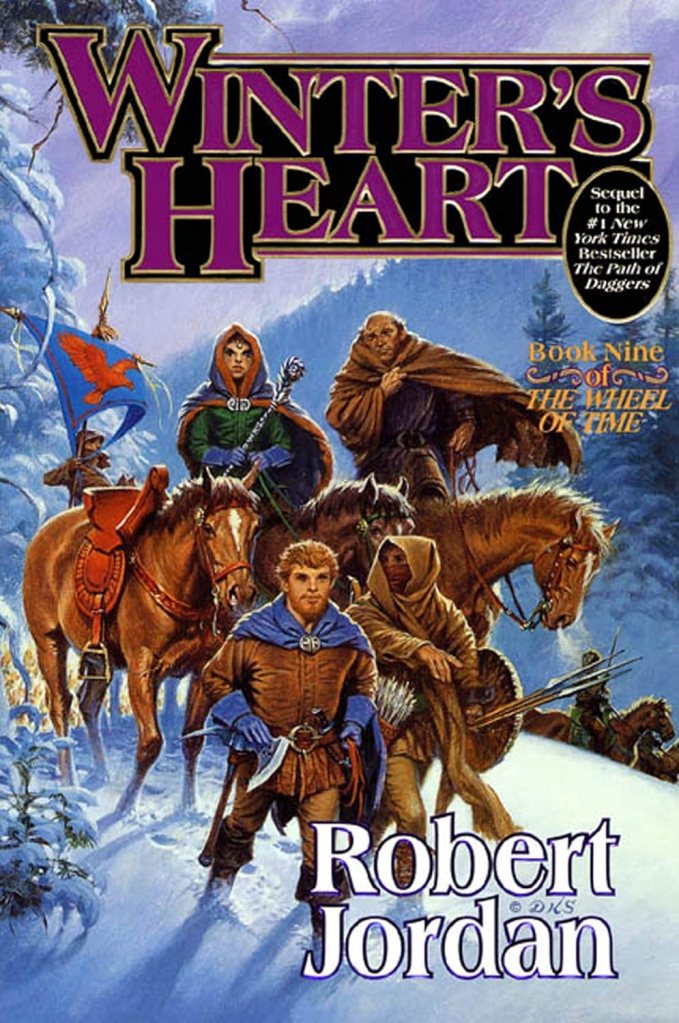
Nine books into Wheel of Time, a series famous for its length and detail, I found myself thinking the series could really be longer. That might seem a strange thing to say given the series’ reputation, but it’s true. For as much detail and depth as Jordan explores with his myriad characters, we are still seeing only snippets of each over the course of multiple books. When this is a side character who reappears unexpectedly, it’s not so jarring, but we miss significant segments of action from even the major characters.
This is a good problem to have, though, and one could argue that it’s not really a problem. Rather, it comes down to storytelling decisions. It’s impossible to document everything that happens to the characters, even if you only have one, and if you tried, the product would be unreadable, disjointed, and ferociously tedious. It’s always up to the author to make decisions about what to include and what to exclude, what to shine the spotlight of the writing upon and what to leave to the dim light of allusion and the magic of imagination. One questionable decision (in my personal opinion) is Jordan’s lack of Perrin scenes in this book.
Winter’s Heart starts out by following up on the consequences of some of the final scenes of Path of Daggers, in which Faile is captured by the Shaido. We get several powerful scenes and events as Perrin learns of her capture, and Jordan lays strong groundwork for a difficult character arc that Perrin will go through, which seems like it will become a major point of the book, except that Perrin barely appears again after those first few sequences. Giving us more time with his development and his plot line would add another dimension to the book (and I almost always want more Perrin scenes).
Note that I say “add” to the book, for the lack of Perrin chapters does not correlate to a weakness in any of the other characters’ chapters. Mat reappears, having all but vanished since the beginning of Path of Daggers, limping around Seanchan-controlled territory and giving us important information about the sea-crossing invaders. His scenes, to me, seem like they must be amongst the hardest to write right, because of the way chance, fate, and Ta’veren effects intermingle with his actual abilities and lack of self-awareness. If there is a common characteristic amongst all the characters in Jordan’s epic, it might be that lack of self-awareness. It is a particular skill Jordan leverages to both show the reader this lack of self-awareness, and make it entirely convincing that the characters would lack the perspective to notice.
Not that Rand’s scenes are easy to write. He continues his difficult road, but with new twists in Winter’s Heart. It’s not precisely fair to say he’s been humbled by what transpired at the end of Path of Daggers, but he is taking a different approach in this book. Quieter, lower profile, at least until the end. He’s also increasingly focused on legacy, on building or doing something that will endure after his death or madness and after the Last Battle and what he assumes will be another Breaking. Elements of this were seeded in previous books, but they start to come to the fore here, and they come together in a particular way to form his main objective for the book.
To achieve that objective, he finally reunites with some of the other major characters in the series, from whom he’s been separated for the last several books. One of my favorite relationships in the series is between Rand and Nynaeve. To me, that friendship – I’m not sure if friendship is precisely the right word, but it will suffice (if anything, I suspect they might act more like older sister/younger brother) – is more convincing and real than his romantic entanglements. In particular, Elayne’s relationship with him doesn’t feel as founded as with Min and Aviendha, no doubt in part because he’s spent less time with her.
We talked a little about the yes but/no and tool in our review for Path of Daggers. It’s at work in Winter’s Heart, too, especially in Rand’s scenes towards the end. Just when we readers think we see a glimmer of light for Rand’s character, a chance to turn him away from the path of hardness he thinks he must pursue, that “but” comes and snuffs it away. Yet, at the end, with saidar and saidin working together, we get a genuine note of hope.
Once more, the ending of Winter’s Heart comes abruptly, without even fully resolving the book’s climactic moment. At this point, it feels like the series is gaining steam to go towards the conclusion, though there is much more still for all the characters to do before the Last Battle. That makes sense, since Jordan originally planned for there to be twelve books, meaning the next book would start the final trio of novels. Of course, that twelfth book ended up being three books long. Regardless, the momentum continues, and I look forward to picking up the tenth book before too long.
 IGC Publishing
3 thoughts on “Winter’s Heart Review”