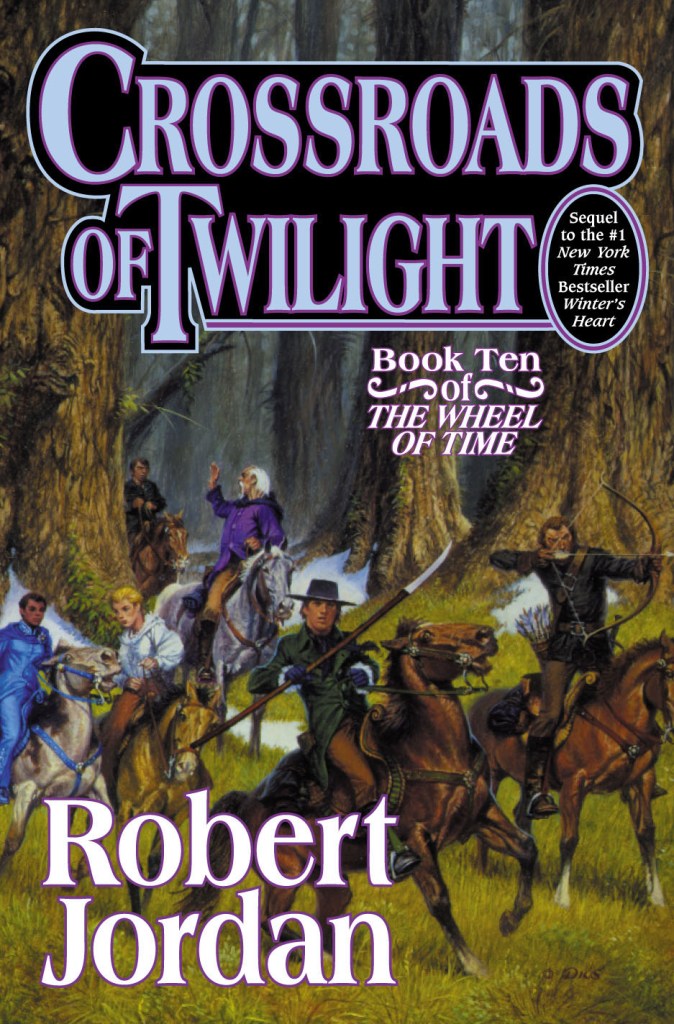
When Sanderson was tapped to complete Robert Jordan’s epic, the story was that there was only supposed to be a single book left to write, but that he said it had to be at least three after consulting Jordan’s notes and outlines. Reading Crossroads of Twilight, though, I wonder if Jordan really still believed, at that point in time, he was going to conclude the series with only two more books. The pacing of Crossroads of Twilight doesn’t reflect it, and I have a hard time imagining a trajectory that would have seen the series to a satisfying and complete conclusion with just two books after this one.
This is not to say that Crossroads of Twilight is a slow read, or that nothing happens. I read a critique recently that, especially in the middle books, Jordan had a habit of spending a whole page immersing the reader in the view of a random street in Camelyn, while hardly advancing the plot in any meaningful way over eight hundred pages. To me, though, that level of immersivity and luxurious detail is precisely what makes reading an epic like Wheel of Time so rewarding. Not that hundreds of thousands of words are required for immersivity, but that really is a prominent element of what makes Wheel of Time such an outsize presence, even for its length, in the epic fantasy ecosystem. Jordan has the time and space to bring even minor elements and characters into the spotlight, bringing them to life in a way that a more focused, shorter presentation could not.
That said, Crossroads of Twilight does struggle a bit with advancing the plot. This is not helped by its somewhat confusing chronology. The end of book nine left us with Rand (probably) having cleansed Saidin, but book ten picks up before that event began, and keeps returning to points before the event began before advancing almost to that point. In a few places it pushes ahead a little, and this nonlinear storytelling provides important context, perspective, and development for other characters and plot-lines, but it’s somewhat frustrating that, even at the end of the book, we’ve barely advanced, time-wise, beyond the end of the previous book. I wonder how the series might read if books nine and ten were interwoven, so that the story is presented more chronologically.
More than the somewhat slow plot development, the frustrating aspect of Crossroads of Twilight is the fact that, for all the reactions we see to the channeling Rand did in book nine to attempt to cleanse Saidin, we don’t have a chance to really see the results of that action. Indeed, it’s not even clear for most of the book whether or not he was successful (since so much of the book takes place before the event happened). In almost every way, this is an incremental book, making small advancements in a wide array of plots. It almost doesn’t feel like a complete book, and the ending comes without anything being resolved.
As an interesting note, it seemed to me that, at least in my copy, there are an unusual number of typographic errors in the text, places where a word is misplaced or an extra word is included where it shouldn’t be. I’ve not noticed this in other books in the series, so it had me curious if the editorial process for this book was different…though not enough to research the matter.
Despite the lack of significant plot progress, you can start to see outlines, pieces moving into position for what is to come, and Jordan’s writing continues to be compelling. Long series aren’t for everyone, but if you’ve made it this far, I think it’s fair for an author to take advantage of the scope of the form to tell a story in a spanning way that shorter forms couldn’t support. There doesn’t seem much point to writing in such a lengthy format if you’re not going to leverage that format to do things a little differently from how they might be done in a more traditional novel or trilogy. That seems exactly what Jordan is doing in Crossroads of Twilight.
 IGC Publishing
3 thoughts on “Crossroads of Twilight Review”