
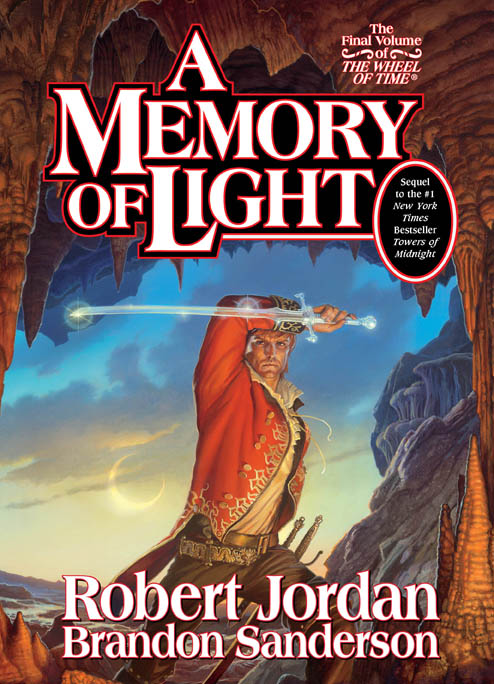
There are no beginnings or endings to the wheel of time, but with the conclusion of A Memory of Light, we come to an ending. Well, from a book review perspective I’ll be writing an overall series review for next Thursday’s post, but this is where the story ends, fifteen books later (including New Spring). After so many books spent preparing for the Last Battle and Rand’s climactic struggle against the Dark One, we finally witness it. We witness it for almost a thousand pages, since A Memory of Light is basically a very, very long final battle scene. I suppose, after fourteen books of building up to it, it’s proportional.
Proportional it might be, and it never drags, per se, but it’s probably the reason A Memory of Light doesn’t bring me quite the same satisfaction, enjoyment, and vicarious pride which I derive from Towers of Midnight. Most of the meaningful character moments have already passed. They don’t stop being dynamic, but even Rand, probably the most dynamic character in the book, doesn’t change all that much, though he does reframe his understanding of the Dark One and the nature of good and evil. They’re no longer evolving, if that makes sense. This final installment sees them being who they are in new ways, not transforming themselves. Which is appropriate for where it falls in the series, but it does mean the book’s strength rests more on the plot and its twists and turns.
Frankly, those twists and turns are few in number. The largest one is probably Padan Fain, who seems for a brief moment or two like he’s going to play a significant and interesting role, but nothing much ever comes of it. At this point, the pieces are placed, and the dominoes will fall as they’re set, or, to use a more appropriate analogy, the dice have been tossed, and this book exists to show us how they’ll come to rest. Who lives, who dies, and what does the world look like after the battle? Well, those are spoilers, and I do seek to avoid those, but I will say that, for how desperate the battle is often depicted, fewer of the major characters die than would perhaps be expected. I don’t remember if I felt that way when I first read it, but in this reading I did have a distinct sense that many named characters, even in the secondary and tertiary tiers, wore significant plot armor through the Last Battle.
What I did remember from my first reading of A Memory of Light…didn’t actually happen in this book. Turns out that memory was a fake one derived more from Aviendha’s visions in Towers of Midnight than from Rand’s actual confrontation with the Dark One. If I were to make a major complaint about A Memory of Light, it would be a lack of denouement. The Last Battle ends, we get a brief view of who lived and who died, and that’s about it. Sanderson doesn’t give us any hints about how the world looks after the Last Battle, what its consequences are, where people will go and how they will live. If there were ever a series that would benefit from a peek at where people are at maybe a year or two after the Last Battle, it would be this one, and we have a bit of an unresolved plot thread regarding the Aiel and the Seanchan. No, I don’t think that’s a spoiler. Revealing that the world survived for people to live in doesn’t tell you if they’re living under the Light or the Dark, which is the core question the Last Battle is fought to answer.
A Memory of Light is a good book, and a satisfying ending to the Wheel of Time; it is not a great book, and it is not as satisfying as it could be. Not that I’m one to criticize, given my own struggles with writing endings. When I finish it, I’m left with the sense of a sigh, having finished a journey and being content with it, not the intensity of everything coming together and being right and satisfying that comes with some other endings, like The Lord of the Rings. Of course, even if I said it was terrible, you would probably still read it – you’ve made it this far, and who gives up on the last book of a fourteen-book series like this? A Memory of Light does everything it needs to do, and it does it well. I simply would have liked if it did it better.
 IGC Publishing