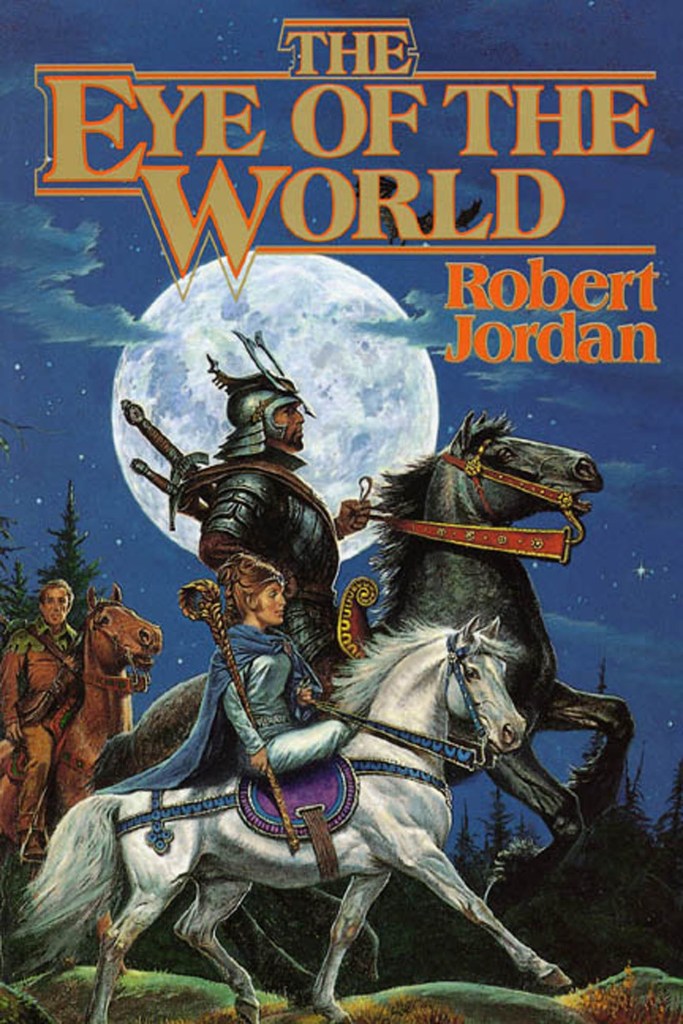
The Wheel of Time turns, and the ages come again – in this case, it brings at long last my reread of Robert Jordan’s Wheel of Time series. Considering that I credit Jordan’s epic with helping to define a new era of fantasy, it is past time that I gave it another read. Speaking of “epic,” this is surely an appropriate application. Your dinner, no matter how protracted and delicious, was not on the level of an odyssey of the Trojan War, but a 14-book conflict between good and evil? That fits the definition.
It’s been well over a decade since I last read Eye of the World, long enough that I forgot many of the details, which is as close as I can come to recreating the magical first read experience. In part to bolster that effect, I chose to read Eye of the World first, rather than the prologue novel New Spring (I’ll read that next). This is where the journey begins…and it kind of shows.
Maybe it’s a trap of my own devising. Often, I assert that much of the reading experience, like other things in life, is about managing expectations, and for my Wheel of Time reread, I have exospheric expectations. Eye of the World, as excellent as it is, is not quite to a standard that perhaps no book could achieve, or perhaps it is simply weaker than the later books, after Jordan had more practice at his craft. Of course, if his writing didn’t improve over the course of fourteen books, that would itself be remarkable. I still thoroughly enjoyed it – it just took me a little longer to get into the story than I expected.
Once I did, though, Jordan’s promise shines. The tension, confusion, and fear that our protagonists feel comes through evocatively, even to a reader who knows much of what is to come. The characterization is also clear, distinct, and strong – it is character and confusion that gives the story the impulse it needs to sustain a plot that offers our protagonists few opportunities to demonstrate agency.
With such length in both this book and the books to come, the worldbuilding is always on display. Part of what I enjoy so much about Wheel of Time is the way that the story has time to lavish attention on seemingly minor details and explore so many settings and peoples. Not just worldbuilding details, either, but character details, plot details, all are substantial, and therefore more satisfying to read than books that might cut details in one area or another for the sake of “tighter” storytelling. It is worth noting that at no point does Eye of the World feel unnecessarily protracted.
Somewhat amusingly, what I least remembered about Eye of the World was the ending. It is far more self-contained than I remembered, standing well on its own, with only a few hints of what is to come over the next thirteen books. Probably because I know that all of those words are still to be told, I forgot how conclusive the, well, conclusion of Eye of the World seems, with only a few suggestions that there is more to come for the reader who doesn’t realize the journey upon which they are now set.
Both to continue reading other books, and to draw out the series, I will be reading other books between each Wheel of Time entry. I think that will improve the reading experience, too – perhaps by the nature of how they were released, these books don’t seem to lend themselves quite as well as some series to being read back-to-back. As another programing note, I will not be discussing the television adaptation – I watched the first season, thought it was horrible, and haven’t watched any of it since. That’s all I’ll be saying on that matter.
Being always ready with another book on my reading list is, most of the time, a fine thing. I enjoy almost everything I read, and I can always pick out another book to read quickly. It will be nice, though, to return to something closer to my old habits, sinking my teeth into a substantial fantasy series and staying with it for a long, long time. If you haven’t already read Wheel of Time, it is the kind of series that every fantasy reader should at least try.
 IGC Publishing
18 thoughts on “Eye of the World Review”