
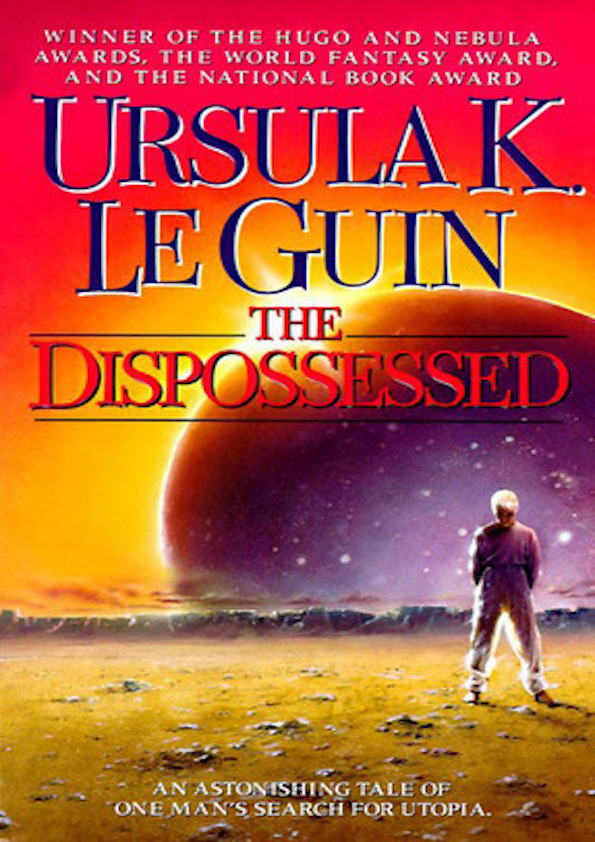
Perhaps is it the era in which the genre came of age that inclines science fiction, more than fantasy and other speculative subgenres, towards allegory, commentary, and the exploration of political and social issues of contemporary relevance through the lens of other worlds and alien circumstances. Many of the genre’s greatest exemplars hail from the 1960s and ‘70s, when the Space Race, the Cold War, and US domestic social movements produced a peculiar confluence of factors which can be seen influencing the stories told, from Star Trek to Foundation. Then again, War in the Air, The Island of Doctor Moreau, From the Earth to the Moon and Around the Moon, Frankenstein, and other entries from what is arguably science fiction’s birth in the mid-nineteenth century can be no less pointed. Sometimes the commentary is there if you care to look for it, and the stories can be read for themselves before examining what they’re trying to say about the real world. In other cases, the commentary proclaims itself, and the story can risk becoming polemical even to the point of unreadability (like Pilgrim’s Progress). Le Guin is not coy about the commentary which The Dispossessed seeks to make on our societies, with only a thin veneer of alienness to create an acceptable distance for her readers to engage with her ideas. Factors like Le Guin’s skill at the craft of storytelling and the focus on characters operating in societies instead of the societies as characters help keep the story from straying over the line into unreadable polemic, but the most important factor is the one which so much of modern discourse lacks: nuance.
Of all the books The Dispossessed most reminds me of, it is The Fountainhead. I suspect neither Rand nor Le Guin would be entirely pleased by the comparison, given their respective political dispositions, although we might be surprised on that count. Contrary to how most readers seem to interpret the book, The Dispossessed is no straightforward pean to collectivism and condemnation of capitalism. Oh, it’s clear in which direction Le Guin’s sympathies lie, despite the narrator’s attempts at neutrality, and the latter is presented in the worst light while the former is given every chance at success, but that seems to make the cracks and flaws in the “ambiguous utopia” all the more significant. Like in The Fountainhead, our protagonist in The Dispossessed is a rare genius whose society does not appreciate him and tries to limit his growth and flourishing. He is awkward, struggles with relationships, naïve or oblivious about things outside of his particular field of expertise, and his attempts to achieve, to actualize the visions in his head, tend towards the tragic. Neither civilization has an answer to the core question raised by the protagonist’s existence. It’s enough to lead one to wonder if there is any societal arrangement that can truly handle exceptionalism well. Even modern, pluralistic, meritocratic subcultures cannot fully answer that challenge. Le Guin originally subtitled the book An Ambiguous Utopia, and that adjective is a fine reminder.
Unfortunately, Shevek (the protagonist) is the only character who is fully realized. This is not to say the characters with whom he interacts are flat or uninteresting, but none of them are developed much beyond the roles they are supposed to fill, and they aren’t dynamic. It’s probably the book’s greatest weakness. You don’t necessarily notice it while reading a given section, because Shevek’s characterization is strong, and he’s the kind of character who tends to be oblivious to others’ internality, but it becomes obvious when you step away from the book and realize how much the story could benefit from additional context and depth of exploration offered by more dynamic side characters. In a few cases, they are on the line of being strawmen for the arguments the book sets out to make.
From Walden Two to The Dispossessed, and across dozens of other works of fiction, nonfiction, and practical experiments, authors, scientists, philosophers, and others have devoted enormous attention to the idea of utopia and the pursuit of that supposed ideal. What The Dispossessed emphasizes most for readers is how futile the pursuit of a single ideal of utopia inevitably is. Not because it is impossible to create a utopia (though it may be), but because it is probably impossibly to create Utopia. Ultimately, that which a given person or even a given society finds utopic is deeply contextual. Aspects of the ambiguous utopia in which Shevek lives which the inhabitants consider ideal come across as dystopian to me (and I imagine to other readers, as well), but I have no doubt that, under the right circumstances, with the right upbringing and social context, it is reasonable for the characters to view it as they do. This is a feature, not a flaw, in Le Guin’s conceptualization, and another aspect of that invaluable nuance which makes The Dispossessed worth reading, rather than being relegated to the status of another generic polemic.
It is certainly a cerebral book, the kind of book which exists in part to force you to question your assumptions as you read it, to pause and seriously consider aspects of social organization and ideas of human flourishing which you may have never contemplated otherwise. The split temporal structure, with alternating chapters focusing on each of the two civilizations, is enabling – I think I would have grown too frustrated with both of the societies represented in the novel if I had to read about each of them in one long block. There’s a variation on the idea of the political circle which I espoused in a previous post on display here, although it would benefit from digging a bit deeper into some of the insights afforded by sociology, psychology, and neuroscience. Still, it’s a thought-provoking science fiction book, and I suspect that it will appeal to many of you.

