
Learning about history, it can be difficult to keep a sense of perspective. Fifty years is not so long ago (and 1976 doesn’t seem like it was fifty years ago), but even if you lived through it, can you reconcile that time with the present, and all the changes which have occurred since then? Go back one hundred years, and the world wasn’t unrecognizable compared to today’s in broad strokes, but the details were all different. How about five hundred years ago, to the early 1500s? Shakespeare wasn’t born yet, Europeans had barely discovered the New World, the Ottoman Empire was young, Babur was waging war into India, and the eastern Roman Empire only recently fell with the conquest of Constantinople. A thousand years ago, the English being spoken would be barely intelligible to the most fluent modern English speaker, the Song dynasty flourished, and the first crusades were launched. Another thousand years before that was the time of Julius Caesar, the events of the New Testament, and the start of the Han Dynasty. To find the origins of Assyria, sometimes considered the first empire, you have to go back more than twice that, to the city of Ashur, circa 3000 BC.
I can write that number. You can read that number. But it’s something else to internalize how long a span of time five thousand years is, how different the world was, and yet how little some things have changed (like taxes). This is before the writing of The Epic of Gilgamesh, before the first civilizations in the Indus Valley, before the Old Testament, predating the Greek heroic age. Then again, Egypt was already on its third dynasty and working to build the great pyramids around this time, and the Epic of Gilgamesh probably existed in some form as an oral story despite not yet being written. The point is that, if the books I read from ancient Greece are old, if the Roman republic is old, if Beowulf is old, then Assyria is truly ancient.
If it seems I am dwelling on the age of this book’s subject matter more than usual, there is good reason for it. That age, and its effect on what has survived and not survived down to the present for archeologists to study and learn about this civilization from, acts like a giant asterisk which must be applied to every claim made about Assyria. As well-researched as Assyria is, with scholarly references, footnotes, and primary sources, it is ultimately and inevitably limited by the constraints of the window we have on such ancient history. It decreases how immersive that history can feel, how tangible it can become, and it leads the book at times to read more like a book of inferences and extrapolations than a book of truly reliable facts. This is not the author’s fault, but it is something to bear in mind while you read.
What we can know about Assyria is primarily based on durable artifacts: buildings, ceramics, bones, metal tools, stone monuments, etc. This provides a surprising amount of detail since the clay tablets on which the Assyrians wrote proved remarkably resilient through the millennia, especially compared to transient paper or parchment media, but it biases the historical record towards what the ancient Assyrians thought worthy of recording and commemorating. Unlike their Babylonian neighbors, this did not include a large base of cultural content – stories, poems, songs – but rather focused on a combination of bureaucratic records and memorialization of kingly deeds. Surprisingly, some of what survives includes receipts and a few troves of ancient Assyrian “business correspondence,” which in translation reads as remarkably modern. Like sometimes occurs when reading historical works from ancient Greece, reading about Assyrian merchants can make the place feel familiar, right up until something incredibly foreign is mentioned.
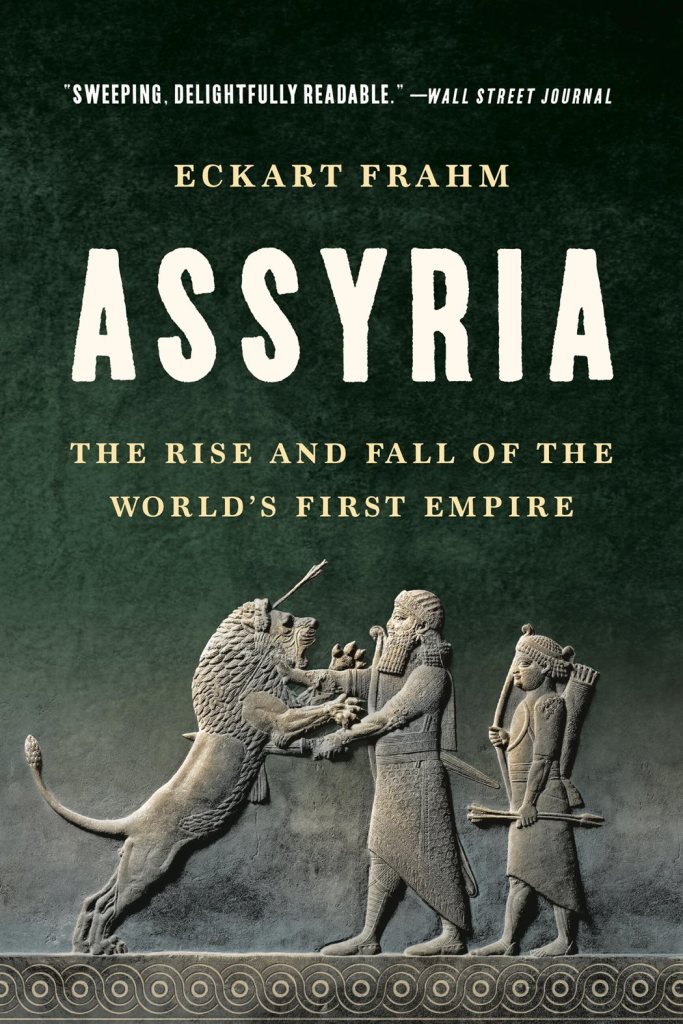
Of the various history books on my reading list, I chose this one for two reasons: Assyria is part of the region and history which inspired the world of Golems and Kings, and therefore reading about it serves a worldbuilding purpose; and it is one of those ancient civilizations about which I know far less despite its centrality. As Frahm points out, the Assyrian Empire is as much a part of our cultural heritage as the Greeks, though they receive far less attention for their contributions. In fairness, that can be significantly attributed to the aforementioned paucity of documentary evidence in the historical record from which to gain insight into their culture. I say “Assyrian Empire,” but the title of Frahm’s book as simply Assyria is probably more appropriate, for Assyria’s age of empire was only a fraction of its overall existence. Comprehending this fraction requires turning again to perspective on time.
Consider the statement that the city of Ashur was founded sometime around 3000 BC, but Assyria as a kingdom came about sometimes around the twenty-first century BC, and Assyria as an empire enjoyed its heyday closer to 800 BC (these dates are very rough – I suggest referring to the timeline in the book for more detail). That is a staggering 2200 years, which makes the history of Assyria longer than the entire history of the current era. Like Egypt, China, and a few other civilizations, Assyria’s history took place along a time scale that makes other states look like mayflies. It puts America celebrating its 250th birthday this year, at barely 11% the entire span of Assyria, into perspective.
Regarding the book, Assyria is a fine, comprehensive survey text. This is not to say that it lacks depth, but it has a lot of ground to cover and limited evidence with which to do it, which means maintaining perspective on how long a certain section covers can be difficult (which is part of why I’ve been emphasizing that concept throughout this review), and that Frahm focuses on what moves the civilization. This is not to suggest the book is exclusively concerned with rulers and ancient geopolitics, but it is to say that this is not the book to turn to for answers about Assyrian architectural tendencies, the clothes different types of people wore during its various periods, what cuisine looked like, or other details, which is responsible for a certain lack of texture to the Assyria Frahm describes. Additionally, while it is well-researched and the content is supported with proper endnotes and references, these are mostly to secondary sources, not primary sources. I would have preferred to see more primary sources leveraged directly, and more discussion of possible disagreements or differing interpretations of the evidence available. At several points, the book reads as more confident about inferences regarding the history it addresses than I think it is reasonable to be.
Thus, I put Frahm’s Assyria as a starting point for understanding this place and time. It is plenty scholarly (rather than being of the “popular” nonfiction variety which might make a stab at including a reference or two but which I generally avoid these days), and wonderfully comprehensive in its coverage of Assyria through its many periods and changes, and I do not mean to diminish the details with which it does furnish the reader. Ultimately, my most significant takeaway from the book is just how much I still have to learn about Assyria.


2 thoughts on “Assyria Review”