
I have six articles for you this week on topics ranging from interstellar comets to dinosaur body temperature, although one of them connects to an additional half-dozen research papers I think you might find interesting. There is always so much more to know, learn, and try to understand; collecting these papers sometimes feels like taking a tiny taste of many different dishes, rather than having a meal. Each one I share is a potential diving board into a vast ocean, or perhaps an entry hole into a complex, underground warren in the tunnels of which you can disappear for days, weeks, entire careers.

A Cold Nursery
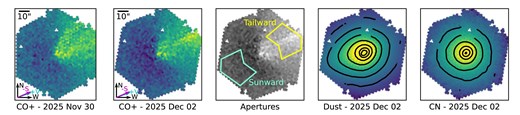
Comet 3I/ATLAS, only the third interstellar body we’ve detected passing through our solar system, was subjected to a panoply of observations by various spacecraft and terrestrial observatories (and continued to be despite having passed its perihelion and its perigee). Ferellec, Opitom, and Snodgrass published this paper identifying that the comet was unusually rich in both hypervolatiles and N2, suggesting it formed under especially cold conditions (for instance, far from its original parent star). To say more is probably to extrapolate and infer too much from this limited data, but it’s certainly fascinating to speculate about this comet’s origins and history that brought it to pass through our solar system after a journey of unknown lightyears.
Read more here: Ion abundances in the plasma tail of 3I/ATLAS show that it is N2-rich | Monthly Notices of the Royal Astronomical Society | Oxford Academic
Rocket Lab vs. Blue Origin
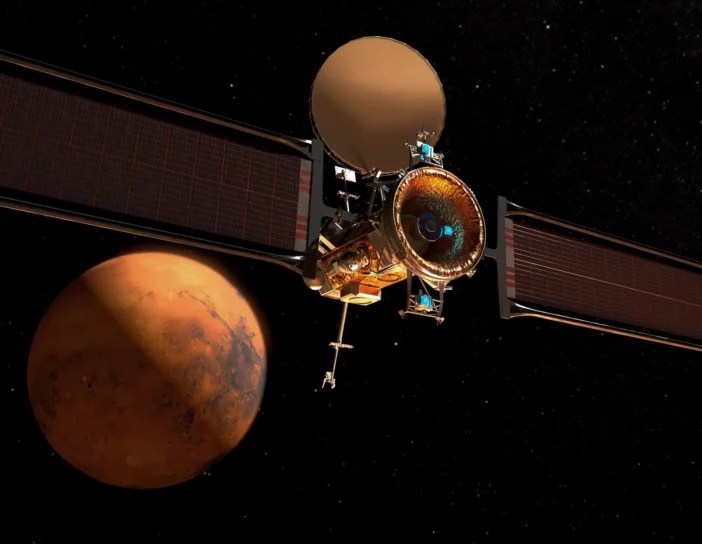
Our announcement a few weeks ago about Blue Origin’s Mars telecommunications orbiter might prove premature. Rocket Lab, which also bid on the mission, filed a protest with the GAO over the decision, which must now be reviewed. This is not uncommon for high-profile missions like this one, and Rocket Lab was particularly invested in the Mars orbiter proposal. In fact, the original language of the request from the government seemed to specifically favor Rocket Lab. We’ll have to wait and see the outcome of the protest.
Read more here: Rocket Lab is seeing red about NASA’s decision on a Mars spacecraft – Ars Technica
Newsflash: Site Dedicated to Storytelling Shares Paper Claiming Reading is Good for You
Of course I had to include a paper on reading for pleasure and how it might benefit us. With the usual caveats that parsing causation from correlation, establishing control factors, determining effect sizes, and teasing out a single thread from all the possible variables are all challenging to say the least, the paper purports to find a link between reading for pleasure and better “cognitive reserve, resilience, and lifelong mental well-being.” If you were looking for an excuse to read more, now you have one in the form of a scientific paper.
Read more here: Reading and associations with brain health, cognition, well-being, and mental health | Psychological Medicine | Cambridge Core

How Should I Spin this One?
Articles and particles can both spin. This week’s issue of Science Advances features a collection of articles about spin-related phenomena. Spin is often poorly explained or understood because it does not analogize well, and because it does not refer to “spin” as we might think of a top spinning. A little like the “colors” subatomic particles can have in quantum chromodynamics, which have nothing to do with actual colors, spin is perhaps best thought of from a lay perspective as a particulate property which can have a state and value and simply happens to be called “spin.” One hundred years of spin: Fundamental physics, dark matter, exotic interactions, and all that | Science Advances gives a thorough review of the subject. Some of the featured papers I found particularly interesting from the issue include: Spin effects in superfluidity, neutron matter, and neutron stars | Science Advances, which examines the interplay of spin at multiple levels under extreme conditions; Optimal control of spin systems | Science Advances, which looks at practical applications of spin to useful technologies; Spin in quantum chromodynamics | Science Advances, which explores the interplay of spin and the aforementioned quantum chromodynamics; Applied spintronics: From spin transport to spin-charge interconversion and emerging devices | Science Advances, another dive into ways of leveraging spin in modern technologies.
Read more here: The next century of spin | Science Advances
65 Million-year-old Fever Test
As is the way of such things, people these days have come to consider the linkages between dinosaurs and birds as practically axiomatic. Practically no one bats an eye anymore at the suggestion that dinosaurs were warm blooded like birds, had feathers like birds, and were perhaps colorful like birds in some cases. I’m old enough to remember when this was still a subject of considerably more controversy, or at least conversation. I read books as a kid which offered up both sides of the debate between whether dinosaurs were cold-blooded reptiles or whether they had to be warm-blooded based on their size and activity levels. We’ve come a long way since then, to the point that Flores et al. claim to constrain the thermophysiology of T. Rex down to a margin of five degrees.
Read more here: The body temperature of Tyrannosaurus rex | Science Advances

3D Printing with Sound
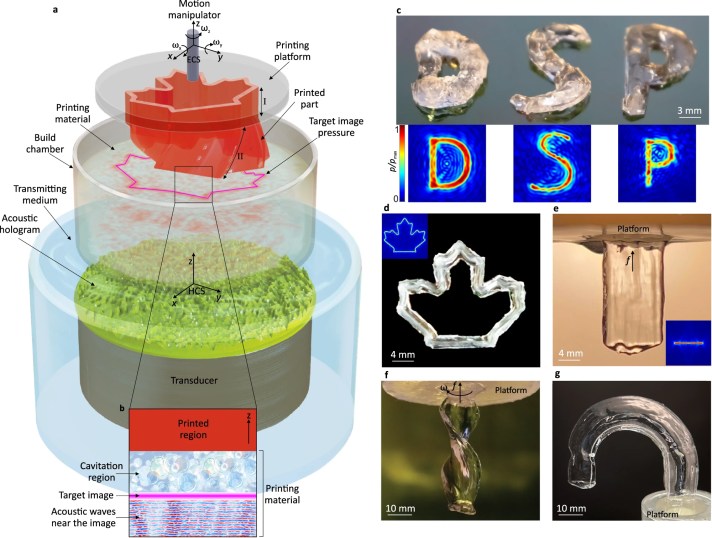
3D printing, or additive manufacturing as it is more technically known, is much more than the fused deposition modeling machines which are most familiar to people. There are versions which print in metal, version which print with lasers, with UV light, version which print in biomaterials like muscles or bones or other cells, resin versions, concrete versions, ceramics versions…I recall even reading about a machine shipped to the ISS which was supposed to 3D print a pizza. I’ve studied these machines in their various forms somewhat extensively, particularly with regards to in-situ resource utilization (trying to answer questions like how and if we could print using materials we find in space, and what we might print if we could). Derayatifar et al. built a machine which uses “holographic direct sound printing.” It’s a fascinating process with a wide array of potential applications.
Read more here: Holographic direct sound printing | Nature Communications
That’s all for this week. If you have questions or have a subject you’d like me to cover in more depth, let me know in the comments.

