
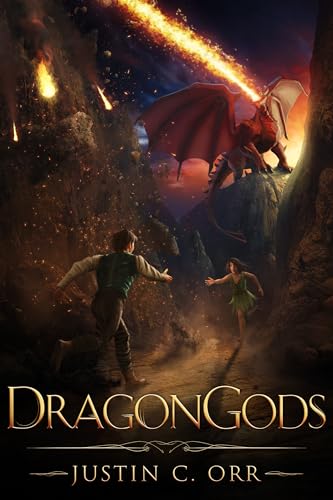
As with DragonForged, I will not be providing a star rating here, as this is a review for one of my writing group members’ books, which I again had the opportunity to read both during drafting and as an ARC. I think Good Reads will force me to select a star rating, so I will default to five stars.
If you want, you can read DragonGods as a straightforward, somewhat predictable, rather tropey fantasy. Orr is pitching it as epic fantasy, and it does have something of that scope about it, although most of its tone is more aligned with quieter, more contained subgenres focused on characters and interpersonal dynamics. There’s the classic young protagonist from a humble background gifted with exceptional magical strength, the mentor figure to teach him finesse, the mysterious and semi-mythical objective. The book is all these things, but it has more layers you might miss if you’re only tuning into those main themes. For me, those other layers are what separate DragonGods from other modern entries from new authors in this particular fantasy subgenre.
One of those layers is represented by SvitCita, a coprotagonist who comes from a culture we catch only glimpses of through most of the book, but those hints of something unusual are revealed to be something thoroughly alien. Her culture, its practices and origins, and how it intersects with the consequences of the book’s climax are mostly groundwork in this book for what is to come in the next, but they go a long way towards differentiating the story and its world from its genre cousins. However, it is the villain’s plot which I find most compelling.
There is something Shakespearean about BiaDar’s plotline. Or, perhaps we should go back further, to the Greek tragedies, for our reference. Here is a young man, arrogant, resentful, possessed of some actual talent and potential, with his own motivations and desires. They might not be exactly sympathetic to us, but he is more than merely a villainous stand-in existing to provide an antagonist for the plot. And, like the characters in those Greek tragedies, he finds being favored with quests for his god is not the pure blessing one might assume. For me, BiaDar’s plotline is by far the most compelling in the book, and that has not changed since the early drafts I was privileged to read. I do not think it an overstatement to claim that it is what brings DragonGods alive and truly distinguishes it from its peers.
It is a fast read, which is part of why it doesn’t always feel quite like it fits the epic fantasy moniker. Orr uses a transparent prose approach and is spare with his descriptions and narration, which certainly keeps the story moving and leaves plenty for the reader’s imagination to supply. I would sometimes wish for a bit more ornamentation, a bit more flourish to the prose to more deeply evoke the moments for the reader, but that is a stylistic preference of mine; frankly, Orr’s style is probably more appealing to a wider audience than mine.
Discounting the novella we reviewed a few months ago, this is Orr’s debut novel, and the first book in a planned trilogy. I know for a fact he’s well into writing of the second book, and he has an exceptionally ambitious publication schedule set for himself – you can learn about all those details in his newsletter if you care to sign up for it. If you’re looking for a book that scratches that classic fantasy itch and blends heartwarming moments with a villain arc suitable for an ancient Greek playwright, DragonGods is worth your consideration. It comes out on November 16th.

