
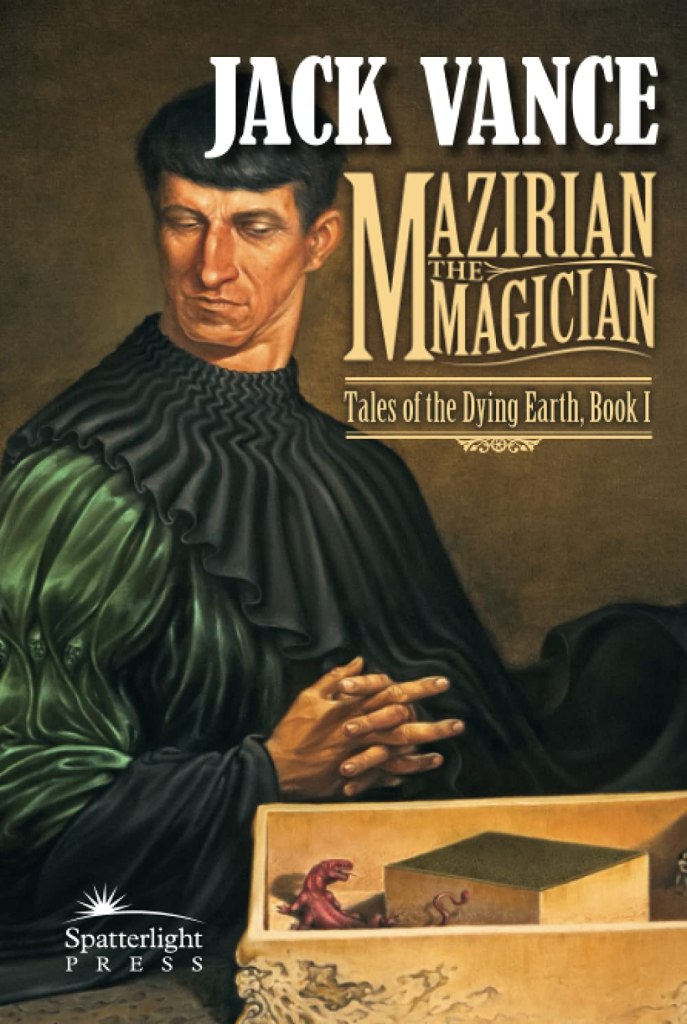
If you pick up this book as the first novel in the Dying Earth series, you will probably be disappointed. It doesn’t read like an entry in a series; it doesn’t even read like a novel. Mazirian the Magician is more like a collection of short stories set in the same world, with each chapter focusing on a different character engaging in a mostly contained adventure. The tone and narrative style are consistent throughout, there are occasional references to people and places across different stories, and in a couple instances (mostly amongst the first few entries) something like a consistent plot through-line can be discerned, but the stories stand on their own. It is considered one of the foundational works of fantasy with profound influence on the genre through the succeeding decades (it was written in the 1940s and 1950s), but I most appreciated it for how it diverges from typical fantasy.
Modern discussions of magic focus on the differences between hard and soft magic systems (popularized by Brandon Sanderson), and from a plotting perspective the magic system present on the Dying Earth is a mostly soft magic system with a few specific hard elements within it, rather like Lord of the Rings features primarily soft magic with a few hard magic trinkets, like the titular One Ring. It does not have definitions laid out neatly for the reader like the laws of physics, nor is it intended to be easily comprehended in or out of the story; therefore, it ostensibly should not be used to solve plot problems. True, but this is not what makes Vance’s magic system distinct and refreshing. What most distinguishes the magic in these stories from magic as a modern fantasy reader imagines it is accessibility. Mazirian and his fellow wizards take us back to an older era’s vision of magic: eccentric, brilliant, capricious sorcerers in towers, dabbling in forces they do not fully understand and leveraging knowledge beyond most mortals’ ken. That modern magic evolved with the democratization of knowledge and the open access movement in science, a process enhanced by the internet (especially its fledgling days when it was full of aspirational, free flow of information ideologies), is probably no coincidence. Modern magic systems, hard or soft, are assumed to be accessible; Vance takes us back to alchemists with secret formulae and natural philosophers jealously guarding their secrets and discoveries, writing notes in code, and masking their real procedures behind meaningless rituals and pageantry.
This approach to magic is both markedly refreshing and ideally suited to the setting Vance sketches. Technically, it is Earth, not a secondary world setting, but it is an Earth so far into the future – billions of years – that the sun is dying and there is nothing familiar about it save for the basics: humans exist, there is familiar gravity and atmosphere, and some of the basic types of plants and animals are still around, though usually in different forms. This is not particularly realistic from a scientific perspective – the sun will eventually turn red as it dies, expanding to engulf most of the inner planets (possibly including Earth), but it will render Earth quite uninhabitable in the process, and the chances of humans existing in a recognizable form after some five billion years are almost nonexistent – but that doesn’t distract from the premise of the idea, a brooding setting populated by characters who know they are living in a kind of epilogue. In Vance’s setting, everyone knows the world is in the process of ending, that the great glories of their ancestors are past and beyond their comprehension or ability to replicate, and all they can do is live out their lives as best they can in the moody light of their dying sun. It’s built into the atmosphere, into the societies which exist, into the morality (or lack thereof) on display, and it informs the aforementioned magic system and how it is employed.
Vance’s rhetoric builds into this feeling as well. Some describe his writing as unduly ornamented, but I disagree. Firstly, he leverages the breadth of the English language to deploy precise terminology to succinctly express what he intended to depict, especially in terms of setting. Rather than endlessly banal hills, valleys, and other basic geographic features (which seem to be all the characters in modern books ever encounter), Vance’s characters traverse rills and loess, ergs and hummocks, buttes and cuestas. The few places where a particular polysyllabic term crops up unexpectedly or out of place in the rest of the writing, I find it serves to enhance the setting. The Dying Earth is all about fragments of historical grandeur protruding into the diminished present like the Assyrian ruins Xenophon witnessed and remarked upon during his travels, and the use of more obscure, “intellectual” words is a kind of rhetorical reflection of this idea which serves to further amplify the tone, the setting, and the characterization of the story.
Thus, though the plots are not apparently connected, the stories themselves are, and the collection contrives to present as a unified piece for the reader. With its variety of the vignettes, Mazirian the Magician still tells a cohesive story for the reader, just not in the way we normally understand the idea. It’s a bit like how a collection of fables can give an overall consistent sense of a culture. Despite, or perhaps because of, how it jumps from one character and adventure to another, the book ultimately communicates a fuller and more immersive sense of the Dying Earth and the various interrelated conceits Vance uses the setting and stories to explore than it would if it dogmatically followed a unified plot. It’s actually the closest thing I’ve read to what I’d like to eventually do with the Archmage and the Unicorn Queen and its related stories. To that point, I am glad I had the ideas for, and wrote some of, those stories before reading Mazirian the Magician; its mathematically inspired magic system and several other elements are all ideas I’ve also explored long before this book ever appeared on my reading list.
In these stories, Vance combines his core conceit with a healthy helping of fable, a smattering of satire, a sprinkle of science fiction, a dash of adventure, and a potpourri of fascinating idea-based explorations. The resulting mélange comes together into a harmonious whole which reads as unique and original despite the appearance of common tropes, archetypes, and the book’s obvious influence on latter-day works of fantasy. It’s doubtless not to everyone’s taste (nothing is), but I suspect it will suit most of you quite well.

