
In this day of low-cost 3D printers, $5.00 microcontrollers, and online custom fabrication services including PCBs, CNC machining, metal 3D printing, and more, not to mention the enormous trove of information and reference material available via the internet, perhaps there has never been a better time to do things yourself. With a bit of know-how, a starting point, a goal, and motivation/stubbornness, you can design your own key fob or start manufacturing semiconductors in your basement. All that is true, but it’s still a long, difficult path from idea to implementation, which is why even a somewhat fundamentalist engineer like me buys things I could doubtless design and make for myself. Most of the time, that doesn’t bother me too much, because it’s usually possible to find a solution someone else already made that will work pretty well to address your particular problem, or maybe there’s a good reason, after some further research, why the solution doesn’t already exist.
Sometimes, though, a notion gets lodged in my brain which I just can’t shake, for something that seems like it should be easy, obvious, such that a solution should already exist…but I can’t seem to find one that does just what I’m looking to do, and making it myself (or modifying something similar myself) presents its own set of complications. That happened to me recently when setting out to choose a new kitchen faucet (I’ve alluded a few times to the remodel my wife and I undertook). At first, I had every intention of simply purchasing an ordinary faucet without thinking too much about it beyond its features and the number of holes it required putting in the new countertop, but my wife was interested in having a faucet with a motion sensor, so it could turn on without using the handle if your hands are full or dirty. There’s nothing revolutionary about that technology, and there are plenty out there from which to choose that let you still operate it with the ordinary handle, too (and without requiring a Wi-Fi connection, since I refuse to have things like faucets start serving me advertisements and requiring a subscription).
Such motion-sensing faucets require power, of course, which is acceptable. What they don’t advertise is that if they do not have power, the faucet won’t work at all. Not just the motion sensor – using the normal handle will not work if there is not power to the unit. That is, to me, a deal breaker. In the event of a power outage, I don’t want my faucet to be rendered inoperable. Surely, if I did some additional research, I would find a faucet out there with hands-free features that still operates like a normal faucet with or without power.
I did find it, or something close enough. It’s a pedal-actuated faucet instead of a motion sensor, and the company has a version which can be applied aftermarket to an ordinary faucet, or their own faucet with the technology built in. The aftermarket version doesn’t allow simultaneous control using both the pedal and the handle, though – you have to switch between modes – and it still requires an electrical unit with a manual bypass in the event of a power outage. Their custom faucet is closer. It still requires an electrical connection for full operations, but the faucet will operate without, and the faucet accommodates inputs from both the handle and the pedal without requiring intricate or inconvenient switching. All this is very close to what I was looking for…at about five times the price I intended to pay.
Looking at the problem as an engineer, it shouldn’t be this complicated. When I grew frustrated with not finding what I wanted, I made a little diagram to put straight in my head how I would do the plumbing for a faucet that offers simultaneous control through both a pair of foot pedals and an ordinary handle. I’ve included a picture of the diagram, since explaining it in words alone would be difficult. First, split the hot and cold lines off in two directions each. One pair goes to the normal supply lines feeding the handle control, and the other pair goes to the foot pedal control. The line coming out the other end of the foot pedals, and the line coming out the other end of the handles, should join in the faucet stem. That’s it. Aside from needing to fit a bit more into the faucet body, the faucet itself would stay the same. You can even merge the hot and cold coming off the foot pedals into one line before it gets to the faucet, so you only have one additional line to fit into the faucet, which would join with the output from the handle control and ultimately come out the business end.
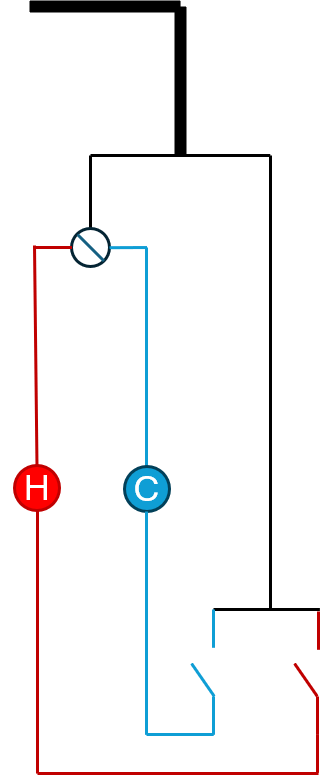
The H and C circles represent the hot and cold water supplies. The switches represent the foot pedals. The circle with a line across it represents the single handle with temperature mixing control. Water flows from the two water supplies both to the pedals and to the handle. The thick black right-angle at the top is the faucet output. In this arrangement, if either the foot pedals or the handle are set to allow water to flow, water will flow normally from the faucet. In Boolean terms, this would be represented by a logical “OR” – if(pedals OR handle)->flow water.
That led me down another rabbit hole in search of faucets that would accept three supply lines instead of two, with one bypassing the handle. For about half an hour, I get somewhat excited because I found them. Three-in-one faucets are a somewhat mainstream thing, though they are intended for a different application than I had in mind. Specifically, they are intended to offer a separate line for filtered water. At first, I figured I could simply use this third supply line to connect to the pedal control valve and thereby achieve what I wanted with a minimum of fuss (and expense). The problem is that these three-in-one faucets don’t accept the same flow rates through the third line intended for the filtered water, severely diminishing the utility for my intended use case. If the point is to make it so that I can wash my gunk-covered hands without touching the faucet, using the foot pedals to elicit a gentle trickle instead of the usual water pressure is not so helpful.
After more fruitless research, I gave up on finding a commercially available solution. I could attempt to make my own modifications to a faucet to enable what I wanted – a challenging proposition to say the least, likely requiring several rounds of prototyping and not insignificant costs – or I could compromise the design. I made another plumbing line diagram, this one for a system which can use either the handle or the pedals, is compatible with any ordinary two-line faucet, but must be manually switched between the two controls. This design has the potential to be extremely simple…if I’m willing to leave the mechanism for switching between controls tucked away under the sink. The other compromise is that the handle must be left open for the foot controls to be primary. Oh, and there’s some complexity to the pedal controls I would want to include that might lead to designing my own.
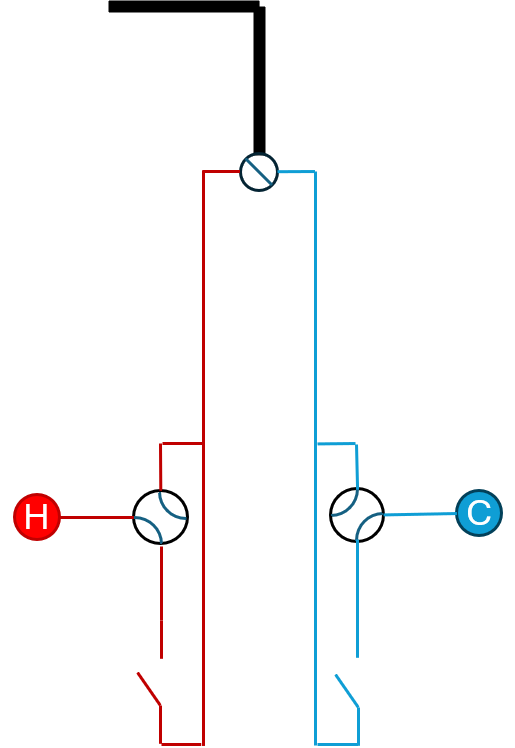
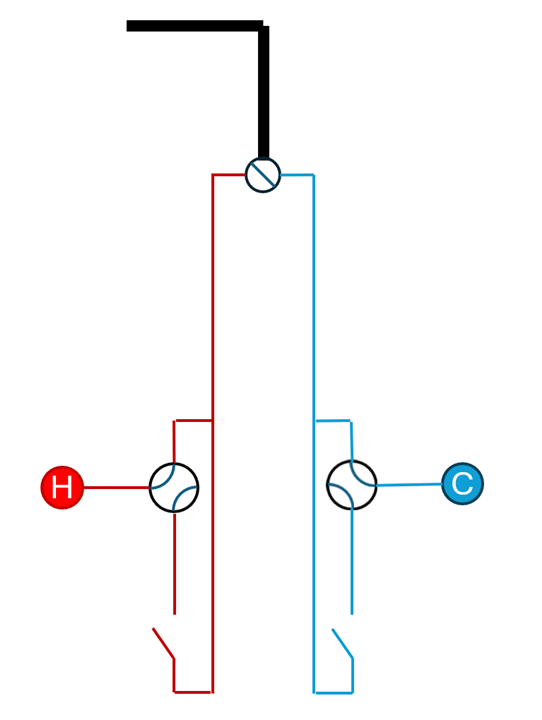
The diagram on the left represents the pedal control case, while the one on the right represents the pedal bypass/handle control case. Note the rotation of the valves connected to the hot and cold supplies. Technically, the left-hand diagram is “AND” functionality in Boolean terms: if(pedals AND handle)-> flow water. The diagram on the right switches functionality to that of a traditional faucet, with just the handle controlling the flow. The left-hand diagram therefore only accomplishes its intended purpose if the handle is left on when pedal control is desired.
The real additional complexity would come from my desire to have the ability to easily switch between the control modes (handle or pedals). To accomplish this, I could a) locate the control switch somewhere easily accessible, which would be ugly and make running the lines more complicated; b) create a mechanical linkage from the control switch to another control switch somewhere easily accessible, or; c) do the lazy engineer thing and slap a servomotor and a microcontroller on it so I could switch between modes with an electronic switch or other actuator located somewhere convenient (at least I could still use either mode without power, unlike the commercial designs).
It was around this point several hours into research and development on this problem, as I began thinking about gears, escapement mechanisms, and how to incorporate those intimidating metal toggle switches with the red safety covers to my kitchen design in an aesthetically pleasing and user-friendly manner, that I thunked my head on the desk, told myself I was being stupid, and reminded myself that I’ve literally lived my entire life with a kitchen faucet which could only be turned on from a normal handle. I do this sort of thing all the time, and I suspect many of the engineers in the audience can relate. Was this all just a waste of time, then? And did I decide to waste your time, too, by telling you about it? Maybe. That’s probably for you to decide, and there is an element of wasted time to this story, but I don’t consider the effort entirely a waste. I certainly learned a lot in the process, including that perhaps there’s a market out there for one of these simpler, cheaper approaches to dual control of a kitchen faucet. I’ve put the basic idea out there now, so if you happen to actually implement one of them and make millions of dollars selling your new and improved dual-control kitchen faucets, maybe consider sharing a bit of the windfall credit?

