
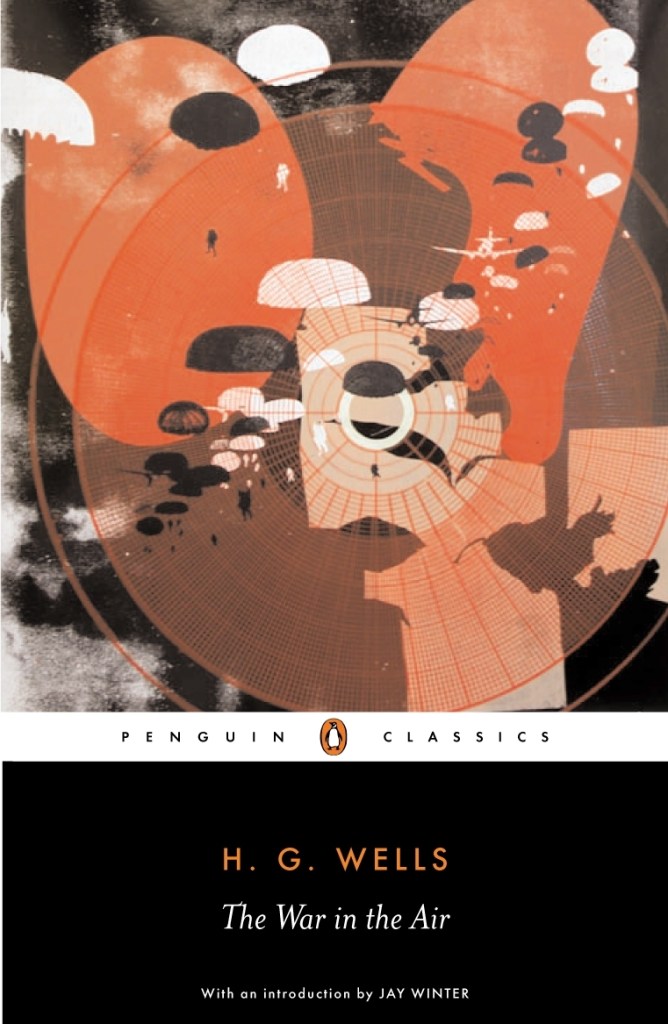
This is a reread, but I first read HG Wells’ The War in the Air in the sixth grade and have only thought of it occasionally since then, so in many ways this felt like reading it for the first time after having read a brief summary or blurb about the book. Especially since it turns out that either my memory of that first read-through isn’t very good, I didn’t understand as much of the nuance and cynicism in the book as I thought I did in the sixth grade, or a little of both. Where I remembered a somewhat ominous and surprisingly accurate foretelling of aerial warfare in conflicts to come, The War in the Air is more a blistering indictment of industry, patriotism, and the “common man” presented through the lens of an expanding global conflict based around airship technology.
Like all prophecies, real events in the twentieth century followed elements of The War in the Air, but in twisted sorts of ways. The book is usually linked to the first world war, but in my view it more closely predicts World War II, with its extensive bombing campaigns and the way war twisted and changed as a result. Wells predicts the way fleets of bombers will make countries once guarded by oceans vulnerable to surprise attacks; the way bombing in the time before precision munitions, and given the increased salience of industry to warfare, would lead to the destruction of urban centers and the increased vulnerability of civilian populations to collateral damage and terror-bombing campaigns; the role of fighters to protect slower and more vulnerable bombers; even the strategic weakness of air forces – that is, their inability to hold territory. These broad predictions are more relevant than the details which Wells tends to get distractingly wrong, like the dominance of airships instead of heavier-than-air craft, or the development of flapping-wing type flyers. However, like much of Wells’ science fiction, the story is less about what was at the time a science fiction rendering of aerial warfare and more about a social commentary and critique on his contemporary civilization.
This commentary is conveyed, sometimes explicitly, by the book’s third person omniscient narrator, who takes a rather dim view of the protagonist, Bert. Even Bert’s last name, Smallways, seems deliberately chosen to diminish him. He’s depicted as something of a bumbling conman, unthinking and uncaring about the state of nations, the world, his place in it, or anything else with which the narrator believes he ought to concern himself. What can be read as his innocence in the book’s early chapters is conveyed more like ignorance, even idiocy, and his ineptitude is what leads him into a position from which the reader can appreciate the advent of aerial warfare and the attendant destructive spiral, which we will address in somewhat more detail in a forthcoming post, which will definitely contain spoilers. In the narrator’s view, Bert is both a victim of the broken and immoral systems in which he lives, and contemptible for his complacency within it. Perhaps this implicit belief in the brokenness and unredeemability of both the systems and the individuals helps grant the author and reader permission for the destruction which is forthcoming.
For, though the narrator makes some gestures to the human toll and tragedy attendant to the war in the air, the downward spiral precipitated by the first battles is holistically depicted with a kind of solemn glee, as of someone who wouldn’t do it himself, and deplores the costs, but who thinks it perhaps for the best that everything burn down. The story’s conclusion endorses this interpretation, for while the narrator never really comes to approve of Bert or his type of person, they and their existences are depicted far more favorably after the novel’s main action concludes. It’s less that the narrator endorses the state of affairs which arises as a consequence of the war in the air, and more that he finds it less abhorrent, more natural, and more fulfilling than the status quo antebellum.
Apparently, Wells is often accused of racism in The War in the Air, which I think is a misreading. Some of the characters certainly are, but to take the ostensibly racist statements made by the narrator at face value is to miss the narrator’s fundamental cynicism. Rather than mindlessly echoing such sentiments, it seems the narrator repeats them in order to highlight how preposterous they are. Nor is the division of the world into the East and West for the core of the conflict either a racist reflection or an unreasonable extrapolation for the time. The terminology certainly reads as antiquated, but a modern reader familiar with the Chinese-Japanese conflict in the second world war misses how that animosity evolved over the decades intervening between this novel’s publication and the onset of that later war. Besides, the book’s critique is primarily focused on nationalism, and touches upon racism only insofar as it is related to nationalism or statism (and remember, the United States and a few other countries are quite anomalous in that there is a minimal ethnic component to their national identities; nation-states traditional build their identities around a certain degree of shared ethnicity). I’m not suggesting there is no hint of racism in the book, but I do not believe it is as egregious, nor the narrator as approving or ignorant of its harms, as critics decry.
Despite Wells’ pessimism, humanity survived its first great “war in the air,” and it survived the Cold War with its threats of global nuclear conflict which followed. With hindsight and given how far technology and culture have moved beyond what is depicted in this novel, it can be tempting to put The War in the Air aside as simply a product of its time, a curiosity with little relevance today. Unlike The Island of Doctor Moreau or some of Wells’ other science fiction novels, there is not an implicit or explicit message warning about the general dangers of science misapplied or of scientific progress run rampant without heed to morality or consequence. It reads more specifically than that, and its social critiques can also be dismissed as specific to early twentieth century Europe (and particularly Britain). However, to do so misses an opportunity, not just to read a rather fascinating and well-composed novel of classic science fiction, but to witness a vision of what might have been, and to reflect upon the critiques Wells offers and how they might apply or not apply today. In fact, it may be more useful now, with a bit of distance, than it was in its own day, for science fiction is often at its best when the distance it gives allows us to consider difficult questions which we might otherwise be inclined to dismiss.

