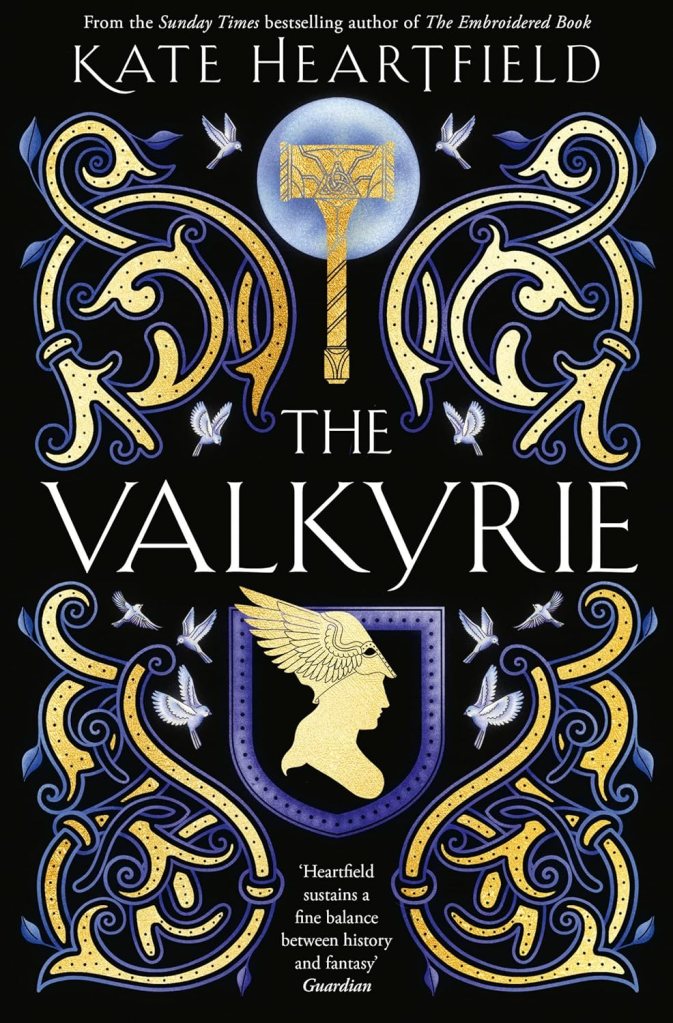
My reading list is fertilized from a variety of sources: peer recommendations, references in other works, organic discovery, and various reading lists from other authors and other sources. Although I’ve only read two of her books, Marie Brennan’s monthly “books read” posts contribute disproportionately. Her interests in folklore, history, and anthropology, and her deep research penchant for historically inspired worldbuilding, align well with some of my own interests and habits in both my reading and my writing. I believe that’s how The Valkyrie joined my reading list, and it (almost) worked for me.
It’s true The Valkyrie is firmly rooted in history and mythology. Heartfield clearly did her research, and the story is firmly grounded in a particular time and place. The specifics and details she includes, from geopolitical dynamics to attire and cuisine, differentiate her setting and context from the typical “stock” fantasy outing; this falls firmly into historical fantasy. The core story is inspired by Norse mythology, but not the surface level modern popular conception of that tradition (Heartfield references both Eddas, the Volsunga Saga, and other works for inspiration). Making the titular heroine a disillusioned Valkyrie makes for a fascinating hook, and she and her circumstances (and the mysteries involved therein) largely carry the story, despite her not being the most motivated and driven of protagonists. Gudrun, the book’s other primary protagonist, is far more active and motivated.
Despite all that, the story struggled to hold my attention. The first few chapters, in which we learn of Brynhild’s exile and combat with the lindwyrm, pulled me into the story, but the rest of the story doesn’t maintain the same pull. On paper, it should have, but there are a few choices Heartfield makes which I struggled to engage with while I read. First, and most pervasive, is the prose, which is serviceable, on the transparent side, and which for me does not support the tone and telling of the story at all. There is no differentiation in the voice from which both perspectives are narrated, and some key moments fall flat not because of anything wrong with the plotting or the moments themselves, but simply because the rhetoric fails to support the contents.
It doesn’t help that the book is plotted and set up from a viewpoint perspective as a sort of love story between Brynhild and Gudrun. The characters exhibit little to no real chemistry on the page which is not contrived by the plot and injected by the narrative voice. Initially, the story seems set up as a quest/mystery, but the narrative voice is more concerned with the rather forced romance between the two viewpoint characters. Brynhild never feels as real and alive as she does in the first few chapters, despite her actions, and while Gudrun continues to by dynamic, the plot’s attention shifts away from her.
A few other aspects also failed to quite work, like the lack of constraints and definitions on Gudrun’s magic where it affects the plot, but the mismatch between prose and tone, and between promises and plot, are what ablated my engagement. The ending was sadly dissatisfying, feeling both contrived and overly straightforward. I kept looking for a twist, a complication, a reveal of what’s really supposed to be happening, that never comes, and what dissatisfying answers we receive are simply handed to Brynhild without much fuss.
Honestly, I’d probably be less disappointed in the result if I didn’t find the core concepts so intriguing. This is a story I wanted to work, that I wanted to see implemented well, and Heartfield just didn’t quite bring it to fruition in a way that satisfied my imagination. To emphasize, it’s not a bad book, and there’s a decent chance you won’t have the same problems I had with it, especially if you’re not going in with my expectations. Sometimes, books and readers just don’t quite match up, and I think that was the case with The Valkyrie and me.

