
I mentioned RSGS in a recent review for Maintenance: Of Everything, which I realize may have been a meaningless reference for some of you. Since it’s also been awhile since I posted a more technical essay or article, I thought I’d put together some of the background on this particular robotic satellite servicing mission, which will also hopefully provide some context for satellite maintenance problems in general.

Space might be the only industry in which it is common practice to design and build a system for operations in the expectation that it must work perfectly from initial deployment until its mission is completed without any servicing, maintenance, modification, or resupply. Those missions often last over a decade and are conducted in some of the harshest environments. No wonder spacecraft are so expensive.
Increased launch capacity and decreased launch costs have helped alter this paradigm in low Earth orbit. LEO spacecraft still go without servicing, maintenance, and resupply, but their missions have been shortened in favor of being replaced at a higher cadence, and proliferated architectures reduce the consequences of a single spacecraft’s failure. It’s not a perfect solution, but it is an improvement over the operational paradigm a few years ago.
GEO, however, remains the domain of expensive, long-lived, unserviced giants. They are expensive to build and expensive to launch, so they must operate for as long as possible, but technological advances can render them obsolete after just a year or two, and minor anomalies can cripple them permanently. Robotic servicing capabilities offer an alternative design and operational paradigm. DARPA’s RSGS, featuring twin robotic arms and launched over the summer, will both demonstrate the feasibility of GEO satellite servicing, and provide that servicing to real customers.
This essay will address the notable payload technologies involved in RSGS, but it will mostly focus on its twin robotic arms, the NRL-developed FREND Mk IIs. It’s been over two decades since DARPA’s earliest robotic servicing demonstration missions (in LEO), so this mission is a long time coming. Both RSGS and FREND are part of a larger history of robotic manipulators on spacecraft dating back to early lunar landers, and there are more exciting developments and innovations to anticipate making orbit in the next few years.
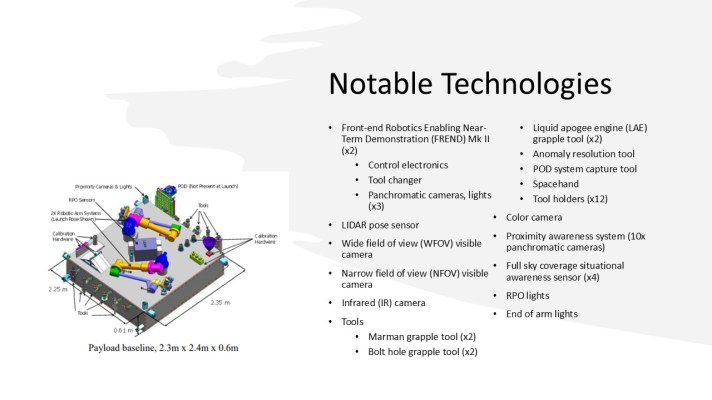
On the left is a CAD rendering of the baseline RSGS payload configuration, prominently featuring the twin FREND Mk II arms. More detail on the arms will be discussed later in the essay, but they cannot operate alone. Along with the arms, RSGS’ payload includes a LIDAR pose sensor, WFOV and NFOV visible cameras, an IR camera, a color camera, and a lighting system for RPO. The proximity awareness system and full sky coverage situational awareness sensors are intended for use with precise orientation and client spacecraft interactions once RPO is initiated. The arms can make use of a variety of tools, including several grappler options and Spacehand, which is a four-fingered humanoid-like robotic hand, and the end of the arm is equipped with additional lights to assist in inspections of client spacecraft.
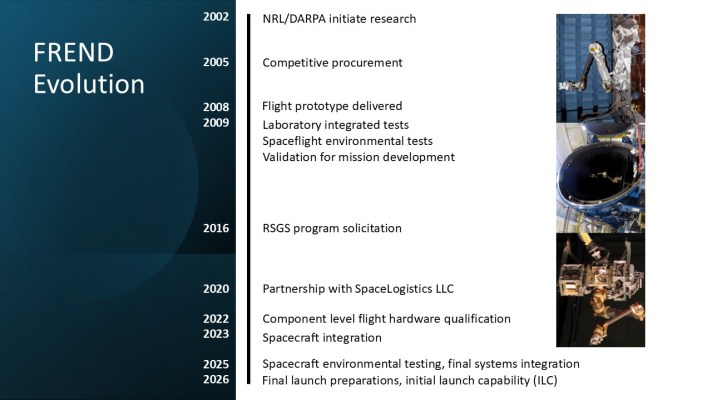
The Naval Research Laboratory and DARPA undertook initial development efforts for robotic manipulators that would lead to FREND in 2002, with the establishment of the space robotics laboratory within NRL. They launched a competitive procurement effort in 2005 for the construction and testing of the Mk I FREND robotic arm, which resulted in a flight prototype by 2008. FREND is robust enough to operate in 1G as well as in orbit, so laboratory testing and environment tests followed prototype delivery. FREND was validated for mission development in 2009.
In 2016, DARPA issued the RSGS program solicitation to integrate the next generation of FREND, FREND Mk II, into a commercially designed and operated spacecraft bus, which led to a partnership with SpaceLogistics LLC, a Northrop Grumman company, in 2020. Based on the specifications in the solicitation, component level flight hardware qualification of bus and payload elements was completed in 2022, and the components were integrated in 2023. Environmental testing and final systems integration took until 2025. Now, with final launch preparations complete, RSGS has initial launch capability and reached orbit aboard a Falcon Heavy over the summer.
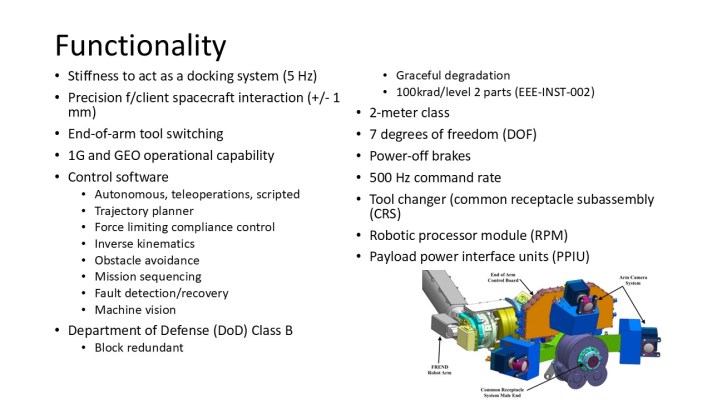
This image summarizes the requirements and specifications for the payload which were laid out in the DARPA program solicitation for RSGS. While the arms are provided by DARPA and NRL, the commercial bus must support them and their operations, which including docking, inspection, servicing, and assisted maneuver activities.
The FREND Mk II is designed as a DoD class B system, meaning it has block redundancies for the arm itself, the avionics, the grapple tools, and the RPO sensors, along with graceful degradation (no sudden and complete failures from small anomalies) of the overall arm system, and parts rated for 100 krad/level 2 according to EEE-INST-002. Technical specifications include sufficient arm stiffness to dock and maneuver with client spacecraft, extremely precise interactions between the end of arm toolset and the client spacecraft, 7 degrees of freedom, 2 meters of reach, and a 500 Hz command rate. Power-off brakes enhance passive safety of flight.
Functionally, FREND supports end of arm tool switching with a dedicated tool changer unit, and leverages independent power interface units and processor modules for operations (although the power initially comes through the bus). The control software enables autonomous, scripted, and teleoperations mode, along with switching logic between the three in the event of faults or other unexpected circumstances. It can plan its own trajectory, monitor its own applications of force, automatically avoid obstacles, optimize its task sequence based on the plotted trajectory, leverage machine vision technology for situational awareness, and perform automatic fault detection and recovery actions.
1970 saw the implementation of a drill on the end of a robotic arm on the lunar surface as part of one of the earliest mission to really earn the monicker “space robot.” Robotic arms in space really gained both prominence and significant technological advancement with the deployment of the shuttle remote manipulator system on Colombia in 1981. Better known as Canadarm, it was used for EVAs, satellite deployments, and satellite retrievals throughout the shuttle’s operational lifespan. It was used to repair the solar maximum mission in 1984, to deploy the Hubble Space telescope in 1990, and for multiple Hubble servicing missions in the following years.
To accomplish what remains arguably humanity’s most ambitious construction effort, robotic arms proliferated during the assembly of the International Space Station. The station received its own upgraded Canadarm in 2001, and an upgraded end effector in 2008. The technology continued to advance, including significant miniaturization – 2018 saw the development of REMORA, a robotic arm compatible with a CubeSat.
The European union delivered another robotic arm to the ISS in 2021 with increased autonomy, and robotic arms of various sorts and with a wide array of end effects have featured on rovers, probes, and satellites deployed throughout the solar system. Several servicing missions in LEO have sought to utilize robotic arms, and now RSGS takes robotic arms to GEO.
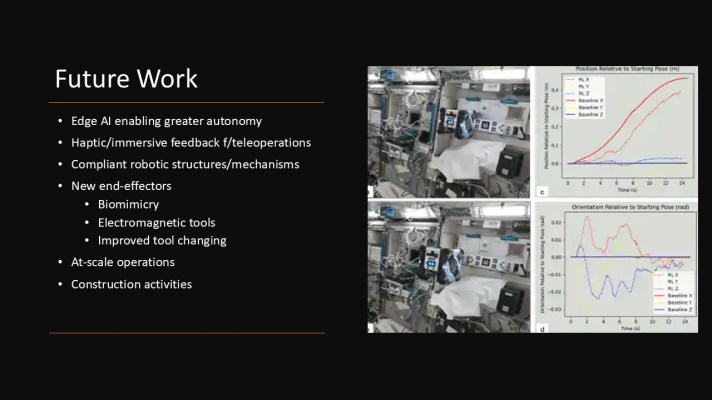
On the software side, two directions of work stand out for producing significant advancements in robotic arms for space applications in the next few years. Incorporating edge AI capabilities stands to enable greater autonomy for arm operations, including prioritization of mission objectives and more adaptive interactions with targets/clients. Advances in teleoperations feedback mechanisms run alongside the advances in automation and should not be considered mutually exclusive.
On the hardware side, compliant or “soft” robotic structures and mechanisms have advanced hugely on Earth, and there is reason to expect these advancements to make their way to orbit in the near future. These can enable robotic arms to perform more delicate operations and reach more inaccessible areas. They will likely bring with them new end-effectors, both in variety, and in faster, more efficient, and more adaptive tool changing.
Changes in application should also be anticipated. Robotic arms proved their usefulness in constructing the ISS. Future space construction efforts, and those on the surface of extraterrestrial bodies, will see robotic arms deployed in space for the first time at scale, both teleoperated and autonomously. These robotic arms will surely form a key element of a durable expansion of human infrastructure into space.
References
[1] C.S. Agency, About Canadarm, Canadian Space Agency (2006). https://www.asc-csa.gc.ca/eng/canadarm/about.asp (accessed June 6, 2026).
[2] S. Kalaycioglu, A. de Ruiter, Advanced Control Strategies for Space Systems: Integration of Model Predictive Control and Neural Networks, in: Advances in Robust Control and Applications, IntechOpen, 2025. https://doi.org/10.5772/intechopen.1010037.
[3] S. Chapin, K. Stewart, R. Leontie, C.G. Henshaw, Autonomous Planning In-space Assembly Reinforcement-learning free-flYer (APIARY) International Space Station Astrobee Testing, in: 2025 International Conference on Space Robotics (iSpaRo), 2025: pp. 418–424. https://doi.org/10.1109/iSpaRo66239.2025.11436341.
[4] Autonomous In-Space Assembly with Arm-Augmented Cubesats – Interactive Robotics Laboratory, (n.d.). https://interactive-robotics.engineering.asu.edu/autonomous-in-space-assembly-with-arm-augmented-cubesats/ (accessed June 6, 2026).
[5] L. Hall, DARPA Robotic Satellite Servicing, NASA Science Mission Directorate (2024). https://www.nasa.gov/directorates/stmd/nasa-to-support-darpa-robotic-satellite-servicing-program/ (accessed May 29, 2026).
[6] DARPA, DARPA-PS-16-01 for Robotic Servicing of Geosynchronous Satellites (RSGS), (2016). https://acquisitioninnovation.darpa.mil/docs/DARPA%20OT%20Programs/RSGS.pdf (accessed May 29, 2026).
[7] G. Roesler, P. Jaffe, G. Henshaw, Inside DARPA’s Mission to Send a Repair Robot to Geosynchronous Orbit – IEEE Spectrum, IEEE Spectrum (n.d.). https://spectrum.ieee.org/inside-darpas-mission-to-send-a-repair-robot-to-geosynchronous-orbit (accessed May 29, 2026).
[8] J. Shoemaker, RSGS | DARPA, DARPA Research (2026). https://www.darpa.mil/research/programs/robotic-servicing-of-geosynchronous-satellites (accessed May 29, 2026).
[9] DARPA’s Robotic In-Space Mechanic Aces Tests, on Track for Launch, (n.d.). https://www.darpa.mil/news/2022/in-space-robot-mechanic (accessed May 29, 2026).
[10] NASA/Marshall Solar Physics, (n.d.). https://solarscience.msfc.nasa.gov/SMM.shtml (accessed June 6, 2026).
[11] NRL Engineers to Lead Payload Development for Robotic Servicing of Geosynchronous Satellit, U.S. Naval Research Laboratory (n.d.). https://www.nrl.navy.mil/Media/News/Article/2529724/nrl-engineers-to-lead-payload-development-for-robotic-servicing-of-geosynchrono/ (accessed June 6, 2026).
[12] J. Giordano, L. Caiaffa, M. Bruschetta, A. Cenedese, Online Trajectory Generation for Space Manipulator via Nonlinear Model Predictive Control, Journal of Guidance, Control, and Dynamics 49 (2026) 537–547. https://doi.org/10.2514/1.G009059.
[13] T. Debus, S. Dougherty, Overview and Performance of the Front-End Robotics Enabling Near-Term Demonstration (FREND) Robotic Arm, in: AIAA Infotech@Aerospace Conference, American Institute of Aeronautics and Astronautics, 2009. https://doi.org/10.2514/6.2009-1870.
[14] R. McCormick, A. Austin, K. Wehage, S. Backus, R. Miller, J. Leith, B. Bradley, P. Durham, R. Mukherjee, REMORA CubeSat for large debris rendezvous, attachment, tracking, and collision avoidance, in: 2018 IEEE Aerospace Conference, 2018: pp. 1–13. https://doi.org/10.1109/AERO.2018.8396814.
[15] Y. Xiao, Y. Jin, H. Yan, Y. Dou, G. Cui, F. Li, T. Meng, Review and Prospect of On-Orbit Servicing Technologies, Adv. Astronaut. 8 (2025) 107–127. https://doi.org/10.1007/s42423-025-00182-6.
[16] C.S. Agency, The history of Canadarm2, Canadian Space Agency (2018). https://www.asc-csa.gc.ca/eng/iss/canadarm2/history-of-canadarm2.asp (accessed June 6, 2026).

